Toolkit for RELOCAtable Temporary Accommodation on Meanwhile-Use Land
Sponsors and Contributors

Proposal
Local authorities across the UK are finding themselves on a burning platform created by the Temporary Accommodation (TA) emergency, including 172,420 children now living in long-term managed homelessness as of December 2025 according to MHCLG Live Tables. Data released in September 2025 by Homes England approximates the annual cost of TA as £2.8 billion in England alone.
While the long-term solution is to build more affordable and social rent homes, we also need innovative strategies to alleviate the TA pressure in the short-term that effectively address existing borrowing limitations such as by unlocking private capital.
Bristol City Council and the London Borough of Havering have recently pioneered innovative and successful development models, delivering quality, demountable homes on under-utilised land to provide purpose-built TA on a meanwhile basis. This approach offers a safer, more suitable and sustainable alternative to much of the existing TA provision.
We unpacked these two pathfinder projects in detail at a panel discussion we hosted on the 2nd December 2025, hosted by Places for People and attended by a range of stakeholders across the industry.
The Toolkit
Following the panel discussion, Housing Festival, Places for People and a growing consortium of contributing partners, are producing a toolkit for local authorities/London Boroughs to aid them in appraising and replicating the demountable and leaseback development models that have been piloted in Bristol and Havering.
The new toolkit will consolidate best practice to enable scaling these solutions, and facilitate the rapid deployment of high-quality homes across the country to help ameliorate the TA crisis and improve the living conditions and outcomes of the thousands of households in TA, including over 170,000 children.
As well as clearly defining the opportunity (specific to each statutory authority’s housing pressures, land availability and finance requirements), the toolkit will need to address the narrative, strategic, legal, financial, and management case to support local government colleagues from across different departments to socialise the solution, produce a robust business case, generate political support and form partnerships to enable delivery.
We used the panel discussion on the 2nd December to test the usefulness of a toolkit, as well as to inform the scope and essential elements, so we are confident the production of this resource is widely endorsed by key stakeholders.
The practical details
The plan is to make this toolkit widely available by October 2026.
The toolkit will be freely available to interested parties across client and supplier domains, downloadable from the members area of Building Better Community of Practice (BB:CoP) website. There is no paywall, but BB:CoP membership and sign-in will support ongoing access to secure file-storage, including the latest version of the toolkit, enabling updates and new case studies beyond 2026.
Additionally, the Community of Practice will provide space for ongoing interaction and collaboration to support implementation and iteration of similar solutions.
The ask and offer
Your organisation has expertise that is essential to help statutory authorities successfully deliver or maintain TA. We would like to invite you to be involved in shaping the toolkit with us.
This will be an opportunity not only to showcase your subject matter expertise, but to be part of scaling a solution that will help address an acute pressure for statutory authorities and improve the lives of individuals and families living in unsuitable accommodation.
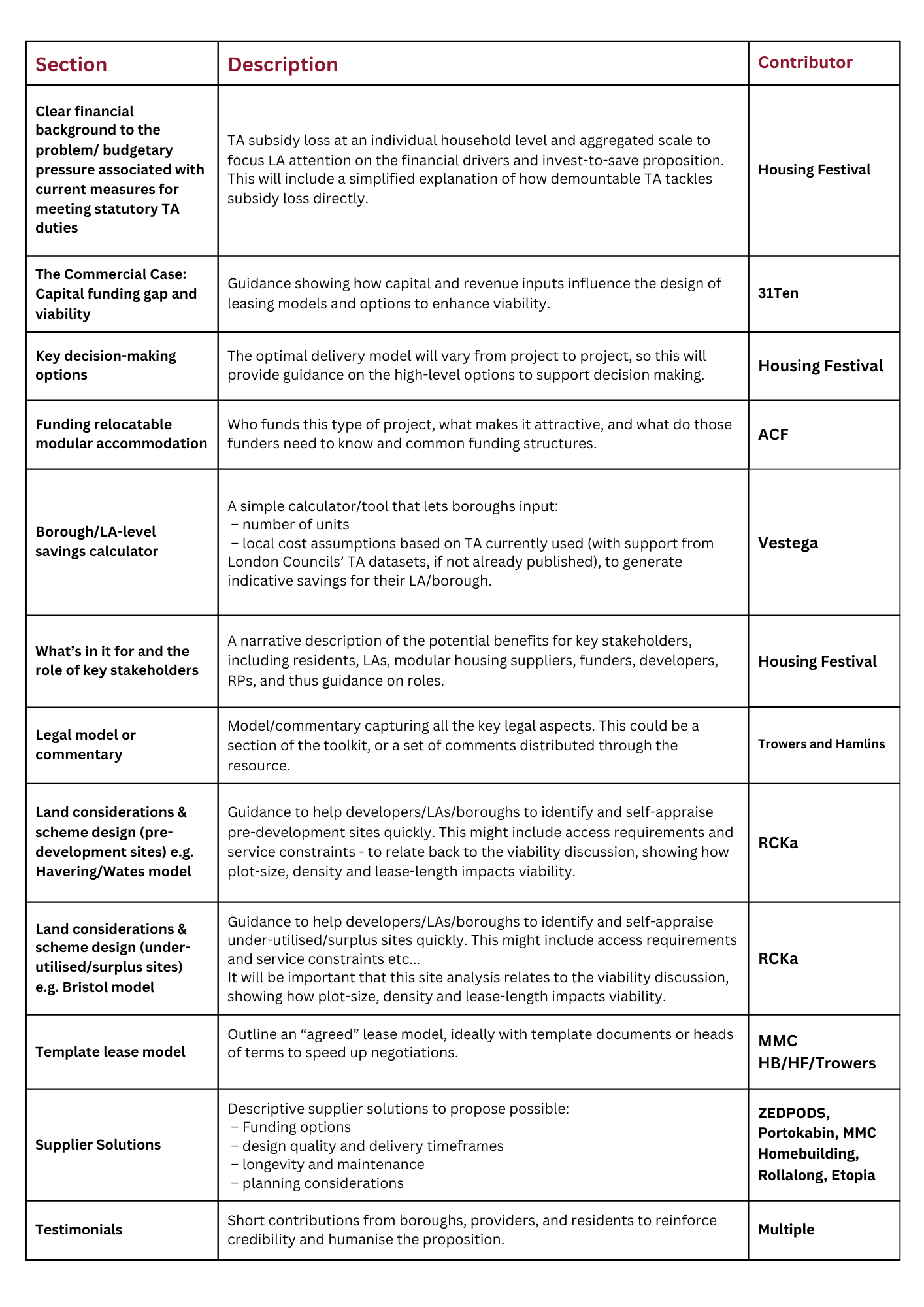
Co-authored and compiled, as was the Social Rent Housing at Pace Playbook (May 2024), the toolkit will comprise of a set of downloadable resources. We have set out overleaf (page 3) the proposed contents of the toolkit,and have indicated in our email correspondence where we think you and your organisation might specifically want to contribute.
The proposed outline (draft)
We want the toolkit to help statutory authorities and their delivery partners to walkthrough the full journey of demountable housing delivery: from understanding subsidy loss to delivering and maintaining modular TA on the ground.We are open to further suggestions to improve the useability and impact of the final tool.
To get in touch, email ellen.grist@housingfestival.org.uk